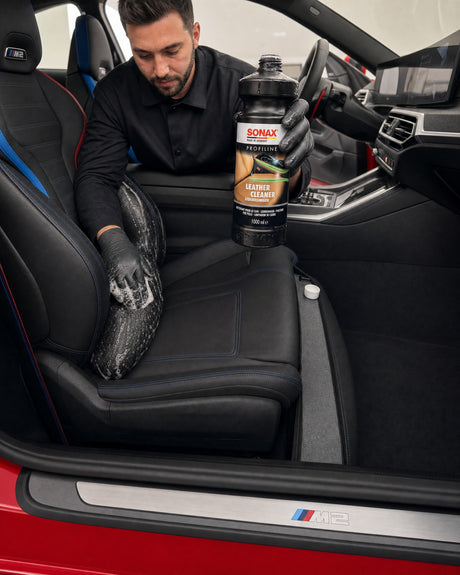
Ledersitze reinigen ist eine Frage des Leders nicht des Reinigers
Daniel von Detailing1 |


| Crowd | Discount |
|---|
ZviZZer HC 4000 "Heavy Cut" Cutting Compound (Red) - 250 ml / Einzeln is on backorder. As soon as everything in your order is back in stock, we ship it all in one go — delivery time follows whichever item takes longest.
Item added to your cart.
View cartDo you have any questions or need help?
We are sure that our help page will help you. There you will find information on how to contact us and the relevant answers to frequently asked questions.
Didn't find what you were looking for? Write us a message in the chat.
Shipping within Germany from €4.90 with delivery times of 1 to 2 business days. Within Germany, we offer free shipping with DPD for orders over €70. For orders over €100, shipping with DHL is also free for you.
Need your order by the next day? Discover Express Shipping starting from €14.90.
We ship your order to 🇩🇪 Germany, 🇦🇹 Austria, 🇨🇭 Switzerland, 🇳🇱 Netherlands, 🇧🇪 Belgium, 🇱🇺 Luxembourg, 🇫🇷 France, 🇮🇹 Italy, 🇪🇸 Spain, 🇵🇹 Portugal, 🇩🇰 Denmark, 🇸🇪 Sweden, 🇭🇺 Hungary, 🇨🇿 Czech Republic, 🇸🇰 Slovakia and 🇸🇮 Slovenia.
Car Care Store in Nordhorn
Why wait when you can get it fast? Order your car care products from us online and choose between convenient pickup or our lightning-fast delivery, whether locally or throughout Europe. We are dedicated to offering you maximum flexibility and convenience so your car always stays in top condition.
You can always pick up your order from Tuesday to Friday, 10:00 to 17:00, at Bosinks Kamp 8 in 48531 Nordhorn at Detailing1. Please have your pickup confirmation ready. We look forward to your visit.
Couldn't load pickup availability
What is the ZviZZer HC 4000 Heavy Cut? A water-based cutting compound on the second-highest cut grade that removes deep scratches, sanding marks from P2000 grit upward and oxidation from weathered paint. It deliberately leaves a light haze and is not the finish — a medium or finishing polish comes after it.
ZviZZer HC 4000 Heavy Cut is a water-based cutting compound from ZviZZer with strong cut, marked Red in the five-step colour system and slotted as the second-highest grade between Pre Cut and Medium Cut. Its high share of homogeneous aluminium-oxide grit cuts fast and evenly instead of scratching, and works out deep scratches as well as sanding marks from P2000 upward. It is silicone- and solvent-free and made in Germany.
Day-to-day from Detailing1: The most common mistake with a heavy-cut compound is reading the haze as a fault and trying to buff it away with more product. The light haze is part of the plan — a coarse cutting compound cuts, it doesn't finish. Spread a pea-sized amount at about 1,000 rpm, work it out at up to 1,800 rpm with medium pressure, and then firmly plan in a pass of medium or finish afterwards. Skip the second step and the haze shows up at the latest in direct sunlight.
You spread the HC 4000 pea-sized at about 1,000 rpm on the damaged spot and then work it out at up to 1,800 rpm with medium pressure, until the scratches are closed and the cut is there.
The prerequisite is clean, decontaminated and masked-off paint. Otherwise leftover tar or fallout settles into the pad and drags fresh scratches into exactly the area you're correcting. Wash the car, clay it, and mask sensitive edges and trim beforehand.
The HC 4000 shows its strength on a hard red polishing pad with strong cut or on lamb's wool, not on a soft finishing sponge. For the red cutting compound the maker recommends a pad in the same system colour, such as the hard Thermo Trapez pad in 125 millimetres. Work in sections of about 40 by 40 centimetres so the grit acts for the same time everywhere.
Keep the pad clean: after two to three sections knock the polishing dust out or swap the pad, otherwise a clogged pad smears and the cut stalls. From our KB day-to-day the rule of thumb is that wool and hard foam carry the strong cut, while too soft a pad overheats the friction and stresses the paint instead of cutting it.
Plan the second step in from the start. The HC 4000 preps the surface perfectly for the MC 3000 that follows, that's its intended spot in the flow. After the cut, wipe down with a splash of isopropanol, check the real result under the polishing oil, and then set up the medium or finish grade.
Paint temperature decides the pace. Below about 15 degrees the water-based grit grabs more stubbornly and the cut takes longer — then a touch more rpm rather than more product. In full sun, on the other hand, the film dries too early; work in the shade and on a cool surface, otherwise the compound dusts and the cut comes out uneven.
The HC 4000 reliably cuts deep scratches, sanding marks from P2000 and oxidation — the high-gloss, hologram-free end state it deliberately does not deliver, it's the stage before that.
Its core ground is heavy correction: badly weathered, matte or fingernail-deep scratched paint that needs real cut before gloss is even on the table. It suits all paint types, including scratch-resistant as well as fresh and cured paint. On a badly weathered bumper one pass rarely does it — there we needed two passes until the oxidation haze was gone.
The difference in grit is the fastest signpost. Sanding marks from P2000 and deep scratches are the red HC 4000's turf. Fine swirls and holograms from about P3000 already fall to the milder orange grade. If you clearly catch the defect with your fingernail, Heavy Cut is right; if not, it's too coarse.
The limits are drawn clearly. If the scratches sit even deeper and the HC 4000 doesn't close them in two passes, the even stronger blue Pre Cut compound belongs in front of it. If there are only light swirls, the HC 4000 is too coarse — then the milder one-step polish is enough, correcting and bringing gloss in a single step.
A second edge case is soft clearcoat. Japanese and some modern paints are so yielding that a coarse cutting compound leaves more haze there than you'd need. On surfaces like that, start one grade milder and rather plan in a second pass than take off too much at once with Heavy Cut. The haze gets removed with medium or finish in every case, never left standing.
On widespread oxidation the HC 4000 plays its strength to the full. A paint gone matte and chalky after years without protection can barely be saved with a mild polish, simply because the initial cut is missing. Here the strong red grit takes off the top, damaged layer and exposes the intact paint underneath — the base on which a later gloss build can hold in the first place.
The HC 4000 is the right call when paint needs real material removal and you want to remove the defect instead of hiding it under gloss. It's a tool for the damage case, not a weekly care item.
It's less suited to two situations: the regular refresh of well-kept paint, for which it's simply too aggressive, and concours reconditioning as a single product, because finishing grades run at the end anyway. If you need the full spectrum long term, you're better off with the graded ZviZZer system from Pre Cut through Heavy and Medium to Ultra Fine than with a single grade.
One question that keeps reaching us in support is whether beginners can use a polish product like this safely. With a coarse cutting compound the honest answer is: carefully. It removes noticeable material and forgives less than a one-step polish, especially on edges where the clearcoat is thin and burns through fast.
Money-wise the choice works out over the bottle size. For a couple of spot scratches on the bumper the 250 ml bottle is enough and you use it sparingly. If you're correcting a fully weathered car or several cars a season, the 750 ml bottle works out cheaper, since a pea-sized amount already covers 40 by 40 centimetres of paint.
The one point the grade chart doesn't tell you: the HC 4000 is no stopgap for gloss chasers, it's brutally honest and cuts off what you give it. Test it on a hidden spot, check the real result under the polishing oil with a splash of isopropanol after the cut, and only then decide on the cut strength of the next step. That control check is exactly what separates a closed correction from paint that looks scratched again after the first wash.
Eine Schleifpolitur trägt mit Schleifkorn Lack ab, um Kratzer und Oxidation zu entfernen. Die HC 4000 ist die rote Heavy-Cut-Stufe von ZviZZer, zweithöchster Abtrag im Fünf-Farben-System. Ihr homogenes Aluminiumoxid-Korn nimmt tiefe Kratzer und Schleifspuren ab Körnung P2000 weg.
Ein hartes rotes Pad mit kräftigem Cut oder Lammwolle, kein weicher Finish-Schwamm. Bei etwa 1.000 U/min verteilen, dann auf bis zu 1.800 U/min mit mittlerem Druck steigern, bis die Kratzer geschlossen sind. Das passende Polierpad trägt den Schliff mit.
Die rote HC 4000 ist eine grobe Schleifpolitur für tiefe Kratzer und hinterlässt einen leichten Schleier. Die orange MC 3000 ist eine mildere One-Step-Politur, die feine Defekte ab P3000 korrigiert und im selben Schritt glänzt. Wenn tiefe Kratzer, dann HC 4000.
Ja. Die wasserbasierte Formel ist silikon- und lösemittelfrei und für alle Lackarten freigegeben, auch für kratzfeste sowie frische und ausgehärtete Lacke. Auf sehr weichen Klarlacken ist sie wegen ihres kräftigen Abtrags aber selten nötig — dort genügt meist eine mildere Stufe.
Mit Vorsicht. Als grobe Schleifpolitur trägt sie spürbar Material ab und verzeiht weniger als eine One-Step-Politur. Teste zuerst an einer verdeckten Stelle, halte das Pad in Bewegung und arbeite mit wenig Material und mittlerem Druck, um Hitze und Durchschliff an Kanten zu vermeiden.
Ja. Die HC 4000 hinterlässt bewusst einen leichten Schleier, sie ist die Abtragsstufe und nicht das Finish. Für ein hologrammfreies Ergebnis folgt anschließend die orange MC 3000 oder eine gelbe Finish-Politur. Eine erbsengroße Menge HC 4000 deckt rund 40 mal 40 Zentimeter ab.
Vor dem Schliff muss der Lack sauber sein: gewaschen, dekontaminiert und an den Kanten abgeklebt. Reste von Teer oder Flugrost setzen sich sonst ins Pad und ziehen neue Kratzer in die Fläche, die du gerade korrigieren willst.
Eine erbsengroße Menge HC 4000 auf das harte rote Polierpad oder auf Lammwolle geben, bei etwa 1.000 U/min auf der Schadstelle verteilen und dann bei bis zu 1.800 U/min mit mittlerem Druck ausarbeiten, bis die Kratzer geschlossen sind und der Abtrag steht.
In Abschnitten von etwa 40 mal 40 Zentimetern arbeiten und das Pad nach zwei bis drei Abschnitten ausklopfen oder wechseln. Ein zugesetztes Pad schmiert nur und überhitzt die Reibung. Bei stark verwitterten Flächen oder tiefen Kratzern sind zwei Lagen normal — ein zweiter Durchgang ist effektiver als mehr Material in einem.
Die HC 4000 hinterlässt bewusst einen leichten Schleier. Diesen entfernst du anschließend mit der orangen MC 3000 oder einer gelben Finish-Politur. Vor dem Nachpolieren die Fläche mit einem Spritzer Isopropanol abziehen und das echte Abtrag-Ergebnis unter dem Polieröl prüfen.
Hinweise: Die HC 4000 ist die zweithöchste Abtragsstufe und entfernt tiefe Kratzer sowie Schleifspuren ab Körnung P2000. Schließt sie die Kratzer auch in zwei Lagen nicht, gehört davor die kräftigere blaue Pre-Cut-Schleifpolitur, danach wieder Medium oder Finish. Für nur leichte Swirls ist sie zu grob — dort genügt eine One-Step-Politur. Auf weichen Klarlacken eine Stufe milder arbeiten. Kühl und frostfrei lagern, nach Anbruch innerhalb von 24 Monaten aufbrauchen.
Contact
Zvizzer International GmbH
Grube Weiß 26, 51429 Bergisch Gladbach, Deutschland
+491773611534
info@zvizzer.com
zvizzer.com
Choose from many payment methods such as PayPal, Klarna, Apple Pay, Mastercard or Visa and benefit from purchase on account and installment payments. Your payment information is always processed securely. Questions about payment?
Your order will reach you in just 1-2 days with DHL, DPD or UPS for orders over €4.90. Shipping is free for orders over €70. Need it faster? Choose from our express shipping offer. We attach great importance to sustainability, which is why our shipping with DHL and DPD is climate-neutral. Questions about shipping?

ZviZZer
Microfiber Cloth “Edgeless” Microfibre Cloth (300 GSM)
Kantenloses 300-GSM-Mikrofasertuch in sechs Farben zum Abnehmen
ZviZZer
Thermo Trapez Pad "Medium" Thermo-Schaumpad (Orange)
Thermo-Schaumpad mittlerer Härte für One-Step-Politur und Korrektur
ZviZZer
MC 3000 "Medium Cut" One-Step Polish (Orange)
One-Step-Politur mittlerer Schleifkraft für Korrektur und Glanz
ZviZZer
HC 4000 "Heavy Cut" Cutting Compound (Red)
Kräftige Schleifpolitur für tiefe Kratzer und Oxidation
ZviZZer
Saures Autoshampoo pH 3,4 bis 3,8 für versiegelte Lacke und Kalk
ZviZZer
pH-schonendes Autoshampoo für die Handwäsche ohne Schutzabbau
ZviZZer
Pad-Reiniger für Schaum-, Woll- und Mikrofaserpads
ZviZZer
Protection Gloss Cream Sealant
Cremige Lackversiegelung auf Wachsbasis für Glanz und 5-7 Monate
ZviZZer
Sprühwachs aus Wachs und Versiegelung für schnellen Glanz und Schutz
ZviZZer
Sprühversiegelung für den nassen Lack mit starkem Abperleffekt
ZviZZer
Wasserbasierter Quick Detailer für Glanz zwischen den Wäschen
ZviZZer
Graphene Spray Coat Spray Sealant
Graphen-Sprühversiegelung für Lack mit Abperleffekt und Tiefenglanz
Daniel von Detailing1 |

Daniel von Detailing1 |

Daniel von Detailing1 |

Daniel von Detailing1 |

Daniel von Detailing1 |

Daniel von Detailing1 |

Daniel von Detailing1 |

Daniel von Detailing1 |

Daniel von Detailing1 |

Daniel von Detailing1 |

Daniel von Detailing1 |

Daniel von Detailing1 |