A spray sealant keeps pollen and resin at arm's length
The question comes up at the counter almost every day right now: can't I just wash and seal my car in one go, now that pollen and resin are sticking to everything? Short answer — washing and sealing belong together, but not in the same second. And it's exactly that little ordering mistake that costs you most of your protection at 33°C.
A spray sealant lays a thin, water-repellent film over the clear coat, one that pollen and tree resin cling to far less and that rinses off more easily next time. This piece walks you through how to decontaminate, wash and seal properly in high summer, which products play nicely together, and the three mistakes that wipe out your protection on the spot.
At 33°C, pollen and resin are working against your paint
In high summer, pollen and tree resin aren't a cosmetic problem — they're a paint problem with a clock on it. The grass pollen count is sitting up in the high range right now, midday temperatures are scratching at 33°C and the UV index is at 7. Those three together are why your dark paint feels dull and rough after a week, even though it still looks clean.
Grass pollen is made of protein grains that swell up in moisture and release organic acids. On hot clear coat those acids act like a mild etchant — they burn tiny matte rings into the top layer of paint. Tree resin is a sticky tree secretion of terpenes and resin acids that only turns liquid in the heat, runs deep into the paint structure and then cures rock hard. Both bond with the surface instead of just sitting on top of it.
Heat and UV are the accelerant here. What takes days at 15°C in spring happens in a few hours under direct summer sun. The paint is heated through, its surface is softer and more receptive, and the organic stuff has a clear run at it. Day-to-day at our showroom in Nordhorn we see exactly this: dark cars that sat under lime trees over a long weekend come back with resin welded on that you could still have wiped off earlier.
You park worst of all under lime, birch or oak trees. In summer lime trees drip honeydew, a sticky-sweet film that pollen and dust settle onto like flypaper. Leave your car a week at the same spot under a tree and you'll be picking off a tough mixed layer of honeydew, grass pollen and the first drops of resin. A space in the carport or a few metres clear of the tree line saves you half the work before it even starts.
Grab a cloth now and wipe dry over the pollen layer and you only make it worse. The hard pollen and dust grains act like fine sandpaper and drag light scratch marks — swirls — into the clear coat. So the first step is never wiping, it's loosening.
Why heat cuts the bake-in time down to hours
The most important number this time of year isn't the temperature, it's the window. In warm, sunny weather you want to get the pollen film and fresh resin off within 24 to 48 hours, before the organic acids leave permanent etch rings. After that it's usually only polishing that helps — and polishing shaves off a wafer-thin layer of clear coat every single time.
The mechanism behind it is simple. Clear coat is a cross-linked synthetic resin whose surface opens up slightly in the heat. Let the paint temperature climb to 50 to 60°C in the sun and the molecule chains get more mobile and the surface more porous. That's exactly the state where resin acids and pollen enzymes press their way in. Meaning: the same resin that's still sitting on top in the shade is down in the paint structure after one afternoon in full sun.
Then there's the water spot issue. Run a garden hose quickly over the car in the midday heat and you can't dry it off, because the water flashes off on its own. What's left is limescale rings from the dissolved minerals in your tap water, baking onto the hot paint. On dark paint those are bright, rough rings you'll later have to grind back out with a polisher.
The takeaway isn't to leave the car alone — it's to pick the right moment and the right order. Pollen and resin have to come off while they haven't baked in yet, and afterwards the paint needs protection that stops the next load from bonding in the first place.

Clean paint is non-negotiable before any sealant
A sealant is only ever as good as the surface it goes onto. Spray protection over a pollen film or resin spots and you seal the dirt in instead of shutting it out. So the right summer order is: decontaminate the trouble spots first, then wash, then seal.
For spot resin and bug residue you reach for a targeted remover, not brute force. Koch-Chemie Orange Power Op works with orange terpenes that soften the resin so it lifts off after a short dwell time without scratching. For dried-on bugs on the front end and mirrors, Koch-Chemie InsectOff steps in, its actives breaking down the protein bonds. Key thing: wet the area first and let the product dwell — never scrub it dry.
Then comes the actual wash. If you want to combine washing and a first layer of protection, reach for a shampoo with a sealant component like Koch-Chemie Ceramic Effect Shampoo Ces. It cleans gently and lays a light hydrophobic film via silicon compounds, so the water beads off on the very first go. Meaning: that counter question — whether washing and sealing work in one step — a shampoo like this answers partly with yes, as base protection and a top-up between the big washes.
For the wash itself, in pollen season method matters more than speed. Work the two-bucket method — one bucket with shampoo solution and one for rinsing the wash mitt, ideally with a grit guard in the bottom. That way you don't drag the loosened pollen and resin particles back over the paint, you drop them in the rinse bucket. Wash top to bottom, because the dirt runs downwards, and dry straight away with a soft drying towel so no limescale rings form on the warm paint.
But you only build the lasting protection afterwards, on the freshly washed paint — still wet or cleanly dried off. This is where the actual spray sealant comes in. It's no substitute for the wash; it's the step that locks in the clean state for weeks.
SC0 Hydro Sealant goes on over wet paint
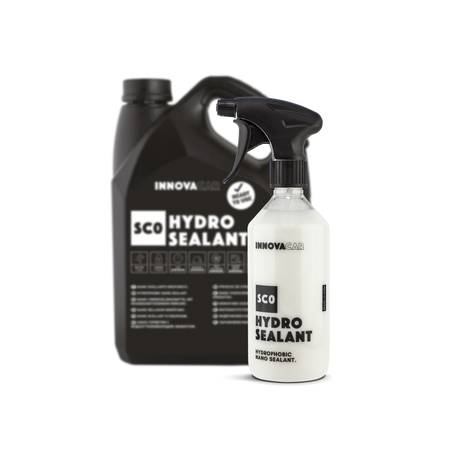
A spray sealant is a liquid paint protection you spray on after the wash and pull off, instead of working it in laboriously like wax. Our pick for summer is INNOVACAR SC0 Hydro Sealant, an SiO2 spray sealant from the Italian maker that you can get over the whole car in ten minutes.
The active is a silicon-oxygen network that lays itself across the clear coat as it dries, like an extremely fine glass lattice. That layer is strongly hydrophobic, i.e. water-repellent: rain and hose water no longer run out into a flat film but pull together into round droplets that roll off. The scene calls that roll-off beading. For you in pollen season it means: pollen dust and dissolved resin barely get a grip on the smooth film and rinse off far more easily at the next rain or the next wash.
The application is deliberately kept simple. You spray the SC0 onto the still-wet, clean paint, spread it briefly with a microfibre cloth and follow up with a second dry cloth. The wet-paint trick is no accident — it makes even spreading massively easier, because the leftover water spreads the product for you. 500 millilitres easily lasts for several full applications on a mid-size car; the 100-millilitre bottle is the ideal size for a first try.
Want something stronger or longer-lasting, and you've got options on the same shelf. Koch-Chemie Spray Sealant S0.02 is a similar, slightly more pro-grade spray sealant. Want a whole season's peace and quiet, look at a proper ceramic spray sealant with stronger cross-linking. A spray sealant typically keeps your back covered for a few weeks to a couple of months, a ceramic system noticeably longer — for a bit more effort.

Three mistakes that ruin the protection on the spot
The most common mistake is sealing in full sun. On paint at 55°C the spray sealant flashes off before it can cross-link, leaving streaky hazes — high spots — that you only get off by washing again. So seal early in the morning, in the shade or indoors, on hand-warm rather than hot paint.
The second mistake is sealing over a pollen or resin film that's still there. If the paint looks clean after the wash but feels rough, there's still contamination sitting on top. Run your fingertip over the surface inside a thin plastic bag and you'll feel every grain. Only once the paint feels smooth does the sealant go on, otherwise you're just sealing the dirt in.
The third mistake is too much of a good thing. A spray sealant doesn't get better if you lay it on thick — the opposite: too much product won't pull off cleanly and dries to streaks. One or two fine spritzes per section is enough, then spread evenly and pull off while the film is still damp. Less product, cleanly pulled off, gives the clearer and more durable result.
And one mistake that happens before you even apply: wiping pollen off with the dry cloth because you're in a hurry. Every dry wipe over the hard pollen layer drags fine swirls into the clear coat that you'll spot as circular scratches in raking light. Better to spend two extra minutes loosening and rinsing than an hour polishing later.
How the protection lasts the whole pollen season
The real payoff of a spray sealant only shows over the season: it makes every following wash shorter, because pollen and resin no longer bond — they rinse off. That's the point where an annoying obligatory Saturday turns into a quick job.
The effect builds. Top up the sealant at every second wash and you lay layer over layer, and the beading gets more pronounced with every application. After four to six top-ups the water beads off visibly rounder than at the start. In high summer with a constant resupply of pollen and resin, that regular top-up makes more sense than one single thick treatment in spring.
Want to go deeper, two related topics from our magazine are worth a look. How you safely remove fresh tree resin within 48 hours we've laid out step by step, and the right order for pollen, resin and thunderstorms on warm paint we sort out in the matching piece. Both round out the protection idea here with the acute removal side.
Which product fits you depends on how far you want to take it. Wash weekly and want it fuss-free, the spray sealant is enough as a quick top-up every second wash. Detail less often and want peace over the whole season, the step up to the ceramic spray sealant with its stronger cross-linking is worth it. And if you're combining washing and light protection in one go, you're well set with the sealant shampoo as a base that you then reinforce now and then with the spray sealant.
In the end the season's logic is simple: pollen and resin are coming anyway, fresh every day. You can fight them off bare paint every time, or you lay a smooth protective film underneath once and the muck slides off it. That's exactly the difference between cleaning up after and thinking ahead.
Detailing1-Insight: The trick hardly anyone uses: spray the sealant onto the still dripping-wet paint right after the rinse, not onto dry paint. The leftover water spreads the product for you, you barely need any pressure and you've got a whole car protected in ten minutes. On a dark-red test car outside our showroom in Nordhorn we once did it the other way round, in the midday sun on dry, hot paint, and half the bonnet was covered in high spots. Ever since, the rule with us is: mornings only, wet only, thin only.

No time for the whole post? Get it summarized: