


Tyre Dressing vs Rain: Spray, Gel or Coating, What Actually Stays on the Sidewall
Daniel von Detailing1 |


Pigmented smooth leather takes more than open pore aniline
Koch-Chemie
Interior Brush "Yellow" interior brush medium-hard
Koch-Chemie
Interior Brush "Red" hard interior detailing brush
Koch-Chemie × COLOURLOCK
COLOURLOCK "Leather Care" Smooth Leather Care Milk with UV Protection
Nourishing lotion for smooth leather with UV protection
Koch-Chemie × COLOURLOCK
COLOURLOCK "Leather Cleaner" (Mild) — cleaner for normally soiled pigmented smooth leather
Gentle daily leather cleaning and care

GYEON
Q²M LeatherBrush Leather Brush
Koch-Chemie × COLOURLOCK
COLOURLOCK "Top Coat" (Dull) Matte Sealing Lacquer for Professional Leather Repair
Matt Topcoat for Leather Surfaces
Koch-Chemie × COLOURLOCK
COLOURLOCK "Leather Shield" Care Product for New Leather to Protect Against Wear
Protect leather from abrasion and maintain its matte finish
Koch-Chemie × THE FINISHER
THE FINISHER "LeatherLock" Leather Care
Universal Leather Care with UV Protection for a Pleasant Feel
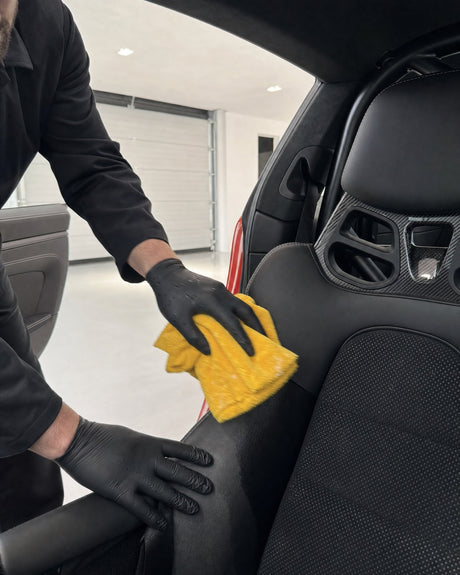
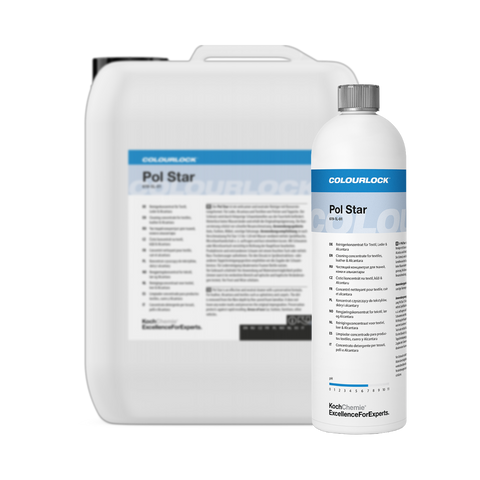
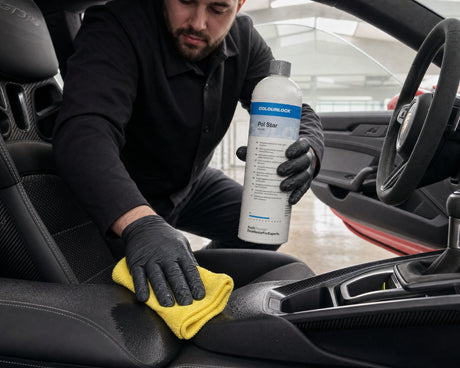
Pol Star lifts hand oils and jeans dye off pigmented seats
Koch-Chemie × COLOURLOCK
COLOURLOCK "Degreaser" Solvent-Free Leather Degreaser for Surface Prep on All Leather Types
Solvent-free degreaser for optimal leather repair preparation


SONAX
PROFILINE LeatherCleaner (foam cleaner)
LeatherCleaner — Professional Leather Cleaner (Foam Cleaner)
How do you look after car leather properly? In two steps, matched to the leather type. A mild cleaner pulls skin oils and grime out of the grain, a re-fatting care product keeps the finish supple. Pigmented leather takes more than aniline or nubuck. At Detailing1 the focus is on COLOURLOCK and Koch-Chemie.
Leather care in a car almost never works on the leather itself, but on its finish — the thin, pigmented top coat that provides the colour and the abrasion resistance. What you see and touch is that coat. It dries out, goes brittle and cracks once its plasticisers are gone. Cleaning strips the layer of dirt on top, care puts back the fats that have been lost. The two belong together, and both have to match the leather type.
Day-to-day from Detailing1: We often see leather cleaner sprayed straight onto the seat and then rubbed in. Two things happen. First, the product runs into the seams, where it pools and lightens the thread over time. Second, the cleaner works unevenly across the panel, because it dwells longest where it first landed — which shows up as a lighter cloud once it dries. Instead, put the cleaner onto a slightly damp sponge, work it up into a foam and lay that foam on evenly. The foam stays up top where the dirt sits and doesn't soak into the seam. Then take it off with a clean cloth that's only damp.
Nearly every mistake in leather care comes down to getting the type wrong. Three types show up in a car, and they differ fundamentally in what they can take.
Pigmented smooth leather is the normal case and covers, roughly, nine out of ten production cars. Sitting on the leather is a colour coat with a clear-lacquer finish. That coat is tough, water-repellent and handles the usual cleaners. A drop of water sits on the surface instead of soaking in — that's the simplest test.
Aniline leather is dyed all the way through and carries no top coat, or only a wafer-thin one. It feels warmer and softer, takes up water straight away and darkens as it does. That's exactly what makes it delicate: an ordinary leather cleaner soaks in and leaves a water ring that never goes away. The COLOURLOCK „Aniline & Nubuck Cleaner" Schonender Reiniger is made for this case.
Nubuck and Alcantara are buffed, so they have a velvety fibre surface. They mustn't be rubbed in wet — the raised fibres lie flat, take on a greasy sheen and only a brush will lift them again. Here you work with very little moisture and brush the nap back up afterwards.
The water-drop test settles it in ten seconds: if the drop beads off, it's pigmented leather and you've got a free choice of product. If it soaks in and the spot darkens, it's aniline and you need a specialist product. Run the test somewhere hidden, like the underside of the seat.
What ages in a car is rarely the hide itself. It's the layer on top.
The finish is made of pigment, binder and plasticisers. The plasticisers keep the whole thing elastic so it moves with the constant flexing of the seat. Over the years they migrate to the surface and evaporate, sped up by heat and by UV coming through the glass. What's left behind is a hard, brittle film.
A hard film cracks under load. That's why the damage always shows first where there's the most movement: on the cushion of the driver's seat and on the left bolster, which your trousers drag across every time you get in. In practice you'll spot it as a fine network of cracks that later opens up into flaking.
A leather care product brings exactly those plasticisers back, usually as fats and oils with emulsifiers that let them travel into the finish. Which means: a seat that's looked after regularly stays supple and doesn't crack — and that's the only window where care does anything. Once the finish has actually cracked, no amount of feeding puts it back together; from there it's a repair job.
The second route to ageing is abrasion. Skin oils and denim dye team up with the friction and act like a fine abrasive, wearing the pigment coat away. Light-beige seats in cars with dark jeans are the classic case — the discolouration sits in the finish and comes out with a strong cleaner, as long as it hasn't worn right through yet.
The routine is short, and the order isn't up for debate.
Before anything else, vacuum. Sand and crumbs in the seams act like sandpaper on the finish when you rub. A soft brush lifts them out of the seam, the vacuum takes them away. On perforated, ventilated seats you're better off vacuuming than pushing moisture down into the holes.
Then comes the cleaner, foamed up on a sponge. Lay it on evenly, let it work briefly, work it into the grain with a soft brush, take it off with a damp cloth. Work in sections of about half a seat so nothing dries on. On badly soiled driver's seats, two mild passes beat one aggressive one.
After cleaning, the leather has to dry — fully. Care on damp leather spreads unevenly, because the water pushes the fats aside. Half an hour at room temperature is usually enough; keep it out of direct sun and away from hot air — both drive out even more plasticiser.
The care goes on thin and gets massaged in. More product doesn't mean more protection here, just a tacky film that grabs dust. After twenty minutes of dwell time you take the excess off with a dry cloth.
With the tools, the brush is what matters. Too hard a brush polishes the grain smooth and creates exactly the greasy shine many people mistake for dirt. Take a soft leather brush with natural bristles and work with no pressure — the cleaning comes from the foam, not from the elbow grease. Add two microfibre cloths: one damp to take off, one dry for the excess.
Don't sit back in until the care has soaked in. Otherwise the product transfers onto your clothes, and the freshly cared-for cushion has lost it exactly where it was needed most.
Our leather range splits into two worlds that serve different needs.
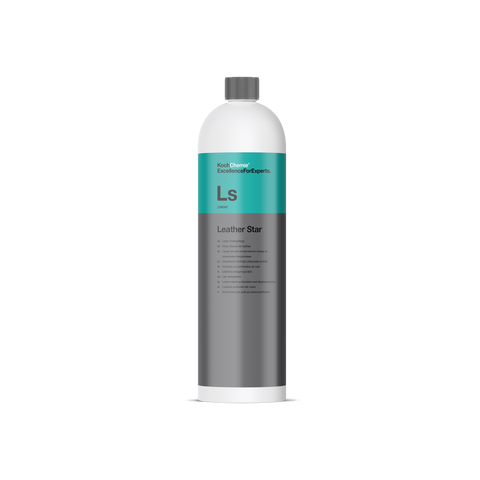
The first world is standard, everyday care. The Koch-Chemie Leather Star „Ls" Lederpflege covers pigmented production leather and is our best-selling product in the category. The THE FINISHER „LeatherLock" Lederpflege adds a variant with stronger protection.
The second world in the range is COLOURLOCK. This line comes from professional leather repair and is graded accordingly finely. There's the COLOURLOCK „Leather Cleaner" (Mild) for regular cleaning and the COLOURLOCK „Leather Cleaner" (Strong) for ingrained grime and denim transfer.
For synthetic leather and vinyl, fitted in many cars on door cards and side bolsters, we carry the Koch-Chemie Allround Leather Cleaner „Alc" Vinyl- Kunstleder- Lederreiniger. Synthetic leather needs no re-fatting, because it isn't hide — here it's only about cleaning and UV protection.
Alongside COLOURLOCK we carry the leather lines of the big manufacturers. SONAX covers the foam option with the PROFILINE LeatherCleaner Lederreiniger (Schaumreiniger), which is especially easy to dose. GYEON splits cleanly into Q²M Leather Cleaner Natural Lederreiniger mild and its strong sister, and Meguiar's handles the quick touch-up round with the Ultimate Leather Detailer Lederpflege.
For a long service life there are ceramic-based leather sealants like the GYEON Q² LeatherCoat (REDEFINED) Lederpflege auf Keramikbasis. They lay down a lasting protective layer instead of a re-fatting film — worth it on light leather you want to protect against denim transfer, and more involved to apply.
On top of that come 17 care sets that bundle cleaner, care and applicators together. For getting started they're the easier pick, because the matching has already been done. The COLOURLOCK „Smooth Leather Care" Set (Pflegeset für Glattleder) is the most-bought of them.
The interval depends on use and on where the car is kept, not on the calendar.
For an everyday car, twice a year does it: once in spring before the sunny season, once in autumn. In between, a damp cloth on the touch points is plenty. Care more often and you get no extra protection, because the finish only takes up a limited amount.
For high-mileage drivers the weight shifts onto cleaning. With daily use the driver's seat picks up far more skin oil than the rest of the interior, and skin oil attacks the finish chemically. Here it pays to clean the driver's seat on its own every quarter and do the rest on the normal schedule.
For a collector's or seasonal car, care matters more than cleaning, because barely any dirt builds up but the leather dries out all the same. A car that stands in the sun for months loses plasticiser faster than one that's driven daily. Re-fat twice a year and lay in a sunshade — together that costs less than an hour a year.
A case of its own is water spots. They form when moisture dries on absorbent leather and leaves the dissolved salts at the edge of the drying area — showing as a light ring. Dabbing at one spot usually makes it worse, because a second ring joins the first. What helps is treating the whole panel evenly, right out past the seam; for stubborn cases the SONAX PROFILINE WaterSpot Remover Wasserfleckenentferner is a specialist product.
On light leather, denim transfer is a job in its own right. It comes out with a strong cleaner while it's fresh. After a year or two the dye has worked so deep into the finish that only a colour refresh will help.
Which products you need is decided by the leather type — and, second to that, the colour.
For pigmented production leather in a dark colour, two products are enough: a mild cleaner and a care product. That covers what the vast majority of cars need, and the choice under leather care and leather cleaners is correspondingly big.
For light production leather, add the strong cleaner, because denim transfer shows up there and the mild one won't shift it. The key is to use it spot by spot and not as your standard cleaner — every pass with a strong product costs you finish.
With aniline and nubuck there's no way round specialist products. The wrong cleaner leaves a water ring here in seconds, and it stays. If you're not sure whether your car has aniline: the water-drop test on a hidden spot settles it more reliably than any options list.
With synthetic leather and vinyl you need no re-fatting, but a cleaner with UV protection. That also goes for a lot of trims sold as „leather" where only the seating surface is real leather and the bolsters and backs are synthetic.
And if your interior is mostly fabric, you're in the right place under Textiles & Upholstery — different actives work there. For an overview of all three material worlds see Interior, and the hard surfaces run through Interior Care.
Too much choice in leather? Get help picking:
Daniel von Detailing1 |

Daniel von Detailing1 |

Daniel von Detailing1 |

Daniel von Detailing1 |

Daniel von Detailing1 |

Daniel von Detailing1 |

Daniel von Detailing1 |

Daniel von Detailing1 |

Daniel von Detailing1 |

Daniel von Detailing1 |

Jasper von Detailing1 |

Daniel von Detailing1 |