

Restoring dull paint: what polish can do and when it does harm
Daniel von Detailing1 |


Dr. Wack "CW1:100"
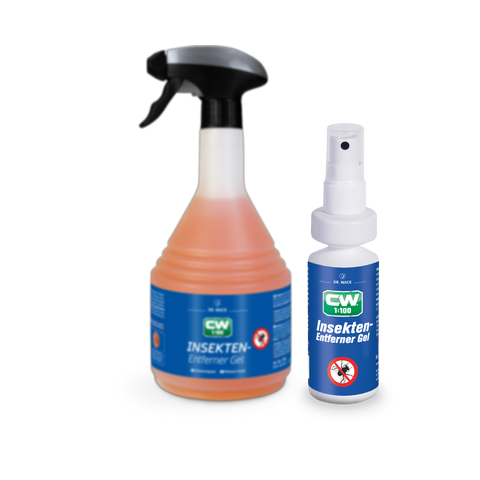
CW1:100 "Insect Remover Gel" insect remover
Clinging bug gel for screen and front end, doesn't run off


Dr. Wack "CW1:100"
CW1:100 "Super" screenwash, ready-to-use
Ready-to-use summer screenwash with anti-limescale formula


Dr. Wack "CW1:100"
CW1:100 "Super" screenwash concentrate
1:100 concentrate for your washer fluid — with anti-limescale formula


Dr. Wack "CW1:100"
1:200 concentrate, a clear view without smear film


Dr. Wack "CW1:100"
Screenwash concentrate made from more than 99 % natural raw materials
What is Dr. Wack CW1:100? Dr. Wack's windscreen series from Ingolstadt. At its core is a screenwash concentrate for the washer fluid that loosens bugs and cuts down smearing. Alongside it, an insect remover gel for dried-on residue on windscreen and mirrors. Summer and winter.
Dr. Wack CW1:100 is the manufacturer's windscreen line for clean washer fluid and a clear view. The concentrate goes into the washer system heavily diluted, loosens bug film and road grime and reduces smearing when you wipe. A ready-to-use summer mix in a 2.8-litre container fills the reservoir with no mixing, and the insect remover gel works on the outside of the parked car. A small line of five products, clearly split by job.
Detailing1's tip from the shop: We often see plain tap water going into the reservoir in summer because the old screenwash has run out. That gives you streaks, limescale marks and, mixed with bug film, a greasy smear that makes visibility worse against the light. Top up with a concentrate from the CW1:100 line instead, summer included. The surfactant loosens the bugs rather than just spreading them around.
Dr. Wack CW1:100 does exactly one job properly: keeping the screen in front of you clear. Everything in the series is about visibility, from the washer system to the dried-on bug residue outside.
The name CW1:100 points to the concentrate principle. The product goes heavily diluted into the washer fluid, so a small volume makes a large amount of ready-to-use screenwash. That's exactly what makes the line go so far: one 250 ml bottle sees the reservoir through many refills instead of being empty after one fill.
A clear view isn't a comfort issue, it's safety. A film of bugs that flares up when the sun's low costs you seconds of reaction time. That's precisely the gap the series works in: it keeps the layer of grime thin enough for the wiper to pull it away instead of smearing it across the screen.
The series is deliberately narrow. Five products, no product jungle. The washer fluid concentrate in three formula grades, a ready-to-use summer mix and the insect gel for the outside. If you want visibility, you get a clear answer here instead of a wall of variants.
Within the brand system, CW1:100 is Dr. Wack's glass specialist. For paint and wheels there's the sister line Dr. Wack "P21S" with its wheel cleaner and sealant, and for ongoing car care the all-rounders from Dr. Wack "A1", the car care line. CW1:100 sticks to the glass.
That split isn't chance, it's method. Every Dr. Wack line has a clear surface, and CW1:100 stands for glass and visibility. Once you've got the system, you don't need to look long: glass means CW1:100, done. That also makes the line easy for beginners who don't want to keep finding their way around detailing from scratch.
The heart of the series is the screenwash concentrate. You don't use it neat — it goes heavily diluted into the washer reservoir and is then sprayed onto the screen through the jets.
In the reservoir, the surfactants go after exactly the films that cause smearing: bug protein, pollen film, road dust and exhaust soot. The concentrate loosens that layer so the wiper pulls it away instead of smearing it. An anti-glare effect means less scattered light dazzles you on the screen when the sun is low.
The split between summer and winter is important. The summer formulas are designed for bugs and summer grime and run without antifreeze. If you use the CW1:100 "Super" screenwash concentrate, mix it with water in summer; in winter, a frost-proof screenwash belongs in the reservoir instead, or the line will freeze when it drops below zero.
In practice that means a clear seasonal switch. In spring, as soon as the first bugs turn up, switch the reservoir to the summer formula. In late autumn, before the first frosty night threatens, the frost-proof winter screenwash goes in. Drive into autumn with the reservoir still half full of summer mix and you risk a frozen line — and in the worst case a cracked pump.
The strength of the concentrate principle is how far it goes over the year. 250 ml makes many times that in finished screenwash, and the 5-litre container lasts a high-mileage driver a whole season. Per refill, consumption stays in single-digit millilitres — measured against the benefit of a clear view.
The jets benefit too. Plain water in the reservoir builds up limescale and algae over time, which clog the fine spray jets. The surfactant in the concentrate keeps the line cleaner, so the jet hits the screen evenly instead of squirting off to one side. It's a side effect very few people have on their radar.
Within the concentrate there are three grades that differ in cleaning power and raw material base. They do the same job, just with different levels of bite.
Classic is the base: a high-yield concentrate for everyday driving with a moderate amount of bugs. Super is the stronger grade for high-mileage drivers and motorway runs, where a thick film of bugs lands on the screen in high summer. BIO relies mainly on renewable raw materials and is aimed at anyone who pays attention to the raw material base while chasing the same clear view.
The choice follows your driving. If you mostly drive in town and on country roads, Classic is enough. If you do a lot of motorway miles in summer and your screen is covered in bugs by evening, go for the Super grade. If where the raw materials come from matters to you, go for BIO, with somewhat more moderate cleaning power than Super.
All three come as concentrate in small bottles from 25 or 40 ml for trying out, up to 250 ml for the season. Classic and Super are also available in a 5-litre canister for ongoing use. That way you can test first and then buy big without switching grades.
Dosing follows the concentrate principle, not one fixed mixing ratio for everything. In high summer with a dense film of bugs, the mix can be stronger; in spring and autumn a weaker one will do. Stick to what's printed on the bottle, because Classic, Super and BIO are set at different strengths and don't suit a one-size-fits-all recipe.
If you can't decide between the grades, go by your mileage. A low-mileage driver doing 8,000 km a year is well served by Classic. From 20,000 km and lots of motorway, Super pays off, because the bug film there is thicker and more stubborn. BIO is the choice if you want the result right without cleaning power being the only criterion.
Alongside the concentrate, the series has two special routes: a ready-to-use summer mix for the reservoir and a gel for the outside. Neither replaces the concentrate; they add to it for clear use cases.
The CW1:100 "Super" screenwash, ready-to-use comes in a 2.8-litre container and is already mixed. It goes straight into the washer reservoir, no water and no measuring cup. That's the easy route for anyone who doesn't want to do maths in summer — in exchange you're carrying more volume per pack than with the compact concentrate.
The insect remover gel works on the outside of the parked car, not in the reservoir. Its gel consistency clings to vertical windscreens, door mirrors and headlights instead of running straight off. That keeps the active ingredient on the dried-on bug residue for 1 to 2 minutes, softens it and lets you rinse it off without scrubbing.
To use it, apply the gel to the dry, cooled screen, not in blazing sun. Leave it for 1 to 2 minutes, then rinse off with plenty of water or via the washer system. With a really thick crust of bugs, a second pass gets you further than waiting longer, because otherwise the gel dries on and leaves streaks itself.
That gives you the division of labour: the concentrate or ready mix keeps the screen clear while you drive, and the gel clears stubborn residue on the parked car that the wiper alone can't shift. Only together do they cover bug season completely.
The ready mix and the concentrate aren't either-or. Many drivers keep the compact concentrate in the boot as a stash for topping up on the road and have the 2.8-litre mix at home for an easy refill. That way you've got the right container for every situation without committing to one route.
Dr. Wack CW1:100 is solid, predictable mid-range with a Made in Germany formula, not a gimmick product. Its strength is reliability over many refills, not one spectacular effect.
Compared with no-name screenwash from a 5-litre canister, the difference is the insect remover and the anti-glare behaviour. Cheap screenwash often smears bug film more than it dissolves it when you're driving into the light. The CW1:100 concentrate is built to loosen the film so the wiper leaves a clear view.
The limit is just as clear: CW1:100 isn't a rain repellent or a glass sealant. It keeps the screen clear while you drive, but it won't make rain bead off like a fluoropolymer coating. If you want long-lasting beading on the screen, you'll also need a proper glass sealant. That's a different product class.
The insect gel has a limit too. It loosens dried-on bug residue but doesn't replace a tar remover for bitumen spatter or a wheel cleaner for brake dust. For iron and paint, Dr. Wack "P21S" is the line in charge, not the glass series.
Head to head with washer tabs or powder, the liquid concentrate scores on mixing reliability. Tabs often don't dissolve fully in cold water and leave residue that causes streaks again. The CW1:100 concentrate is already liquid and mixes in evenly right away, which makes it more predictable to use.
Weigh it up honestly and you get a clear recommendation. For keeping your view clear day to day, the series is a reliable standard choice with a German formula behind it. For specialist jobs like long-lasting water repellency or heavy paint contamination, you'll need extra, specialised products. CW1:100 doesn't even try to cover those jobs, and stays consistent because of it.
The simplest way in is one bottle of concentrate plus the insect gel. That covers you on the move and when cleaning the parked car, and you won't need any other glass care in summer.
For the concentrate, your driving decides. Town commuters start with Classic, high-mileage and motorway drivers with Super, and anyone who cares about the raw material base with BIO. If you'd rather not mix, grab the 2.8-litre ready mix in summer and skip dosing altogether. A small 25 ml or 40 ml bottle is enough to test before you move up to 250 ml or the 5-litre canister.
For the gel, the size depends on how many bugs you collect. The 100 ml bottle is enough for occasional residue; 500 ml or 750 ml pays off for high-mileage drivers and the peak season from May to September. That way you're not constantly re-buying during bug season.
A complete set for the season looks like this: a concentrate in the grade that suits your driving for the reservoir, plus the insect gel in the size that suits your mileage for the outside. Set that up once in spring and you'll get through the whole summer without a last-minute top-up run when the screen's covered by evening.
Bottom line: Dr. Wack CW1:100 is the right choice if you want a predictable glass solution from one maker that runs all year and keeps bug film under control in summer. If you want to look after paint and wheels too, combine it with the CW1:100 "Insect Remover Gel" insect remover and the sister lines, without switching manufacturer.
Too much choice in Dr. Wack "CW1:100"? Get help picking:
Add Detailing1 as a preferred source on Google
Daniel von Detailing1 |


Daniel von Detailing1 |

Daniel von Detailing1 |

Daniel von Detailing1 |

Daniel von Detailing1 |

Daniel von Detailing1 |

Daniel von Detailing1 |

Daniel von Detailing1 |

Daniel von Detailing1 |

Daniel von Detailing1 |

Daniel von Detailing1 |