Pollen in the cabin isn't dust, it's a biological payload
You've just wiped the dash, you get back in an hour later, and there's already a yellowish haze sitting on it again. That's not sloppy cleaning. Grass pollen peaks for the year around late June, and inside a closed cabin something happens to those particles that most people miss completely when they clean a car interior.
Pollen grains are biologically active capsules packed with enzymes and allergens. They cling to plastic electrostatically and come straight back the moment you've wiped. If you want to keep the cabin clean through pollen season, you need the right wiping technique, an antistatic follow-up and a fresh cabin filter. This guide shows you the order to do it in.
Pollen isn't inert dust
Grass pollen grains are microscopic, biologically hyperactive capsules that carry enzymes, proteins and allergens. Unlike dry house dust, they react to the warm, humid microclimate inside the car and spread their organic load across every surface the air touches.
That's exactly why pollen season hits the cabin harder than the paint. On the clearcoat the dust shows up as a yellow-green film that can start to etch chemically in the first 48 hours when it's hot. Inside the cabin that same load lands in a closed, air-conditioned system where nothing rains it off, it just settles and builds up. If you take pollen on the outside seriously, the interior deserves the same attention.
Then there's the sheer volume. A modern car's ventilation pushes up to 500,000 litres of air through the cabin every hour. In peak season every one of those litres carries pollen, and whatever the filter doesn't catch settles on the dash, the centre console, the vents and the seats. Cleaning for looks alone falls short here, because it only deals with the end of the line and ignores the source.
For allergy sufferers this is more than a cosmetic issue. With a saturated filter, the concentration inside can actually run higher than outside, because the particles build up in the closed space. The good news: with the right routine you get both under control, the visible film and the air you breathe.
The timing is what makes this so pressing right now. In Central Europe grass pollen peaks from mid-June into July, and that's exactly when high summer brings long spells parked in the sun and plenty of airflow through open windows. Anyone driving up here in the north knows the back-and-forth: warm, dry days with heavy pollen counts and short showers that pin the dust down for a moment before the next wave rolls in.
Why the pollen film is back the moment you've wiped
The fact that dust reappears on the dash even right after a thorough clean comes down to strong electrostatic processes inside the sealed cabin. The dashboard builds up a charge and literally pulls the particles out of the air.
That charge builds from everyday things. Wiping a dry microfibre cloth over the trim, or just the friction of accelerated airflow against the edges of the vents, is enough to build a serious surface charge. Plastic is an electrical insulator, and that charge has nowhere to go.
Here's a detail almost nobody has on their radar: the car sits on four rubber tyres, and rubber insulates too. So the static charge generated inside can't drain away into the ground. The result is the effect every detailer dreads, a spotless dashboard covered again in a clearly visible yellowish pollen film within minutes to a few hours.
That's why cleaning on its own is a losing battle in pollen season. As long as the charge stays on the surface, it works like a magnet. So the step that matters isn't another wipe, it's deliberately neutralising the static charge after cleaning. That's what separates a pro routine from chasing your tail with a cloth.

Wipe damp, turn the cloth, never scrub dry
By far the most damaging mistake when you clean a car interior in pollen season is the quick, dry wipe, with a bare hand, a paper towel or a dry rag. Dry pollen acts like fine sandpaper on delicate surfaces.
Drag those hard, microscopic particles dry across scratch-prone surfaces, piano-black trim, nav displays or fine-grained soft-touch plastics, and they leave fine micro-scratches behind. In the trade these are called spider webbing or swirls, and they permanently dull glossy surfaces. What was meant as a quick clean then costs you a proper machine polish of the interior.
The right way is damp, with the right cloth. High-pile microfibre pulls the encapsulated dirt deep into the fibres and traps it, instead of pushing it ahead like a short-pile towel does. Dampen it lightly, work with little pressure and turn the cloth after every pass, so a clean, unsaturated face always meets the plastic. The moisture also carries off part of the charge along the way, because water molecules bleed the ions away.
Before any wiping comes the vacuum, with a brush nozzle. Pollen doesn't just sit on the surfaces, it hides in the gaps between seat rails, belt buckles and the centre console. Reach straight for the damp cloth and you just shuffle that stash around. Vacuum first, then lift it with a damp cloth, then dress it, in that order the job stays a one-off instead of a daily chore.
In the vents, where no cloth reaches, work the dust out of the fins with a soft detailing brush, ideally with the blower running so it pushes the loosened particles outward. Only once the surface is genuinely clear does the dressing go on. Work out of order and put dressing on a still-dusty surface, and all you do is grind the pollen in.
Which products actually keep the cabin clean
After the damp clean, the cockpit needs a dressing that neutralises the charge for good, because the short-lived effect of the moisture is gone once it dries. For weeks of protection, an antistatic plastic dressing is the real tool for pollen season.
Our top seller for this is Koch-Chemie Top Star "Ts", a silicone-oil-free dressing emulsion for the plastic and rubber parts inside the cabin. It leaves a satin-matte protective film with UV protection and, the part that matters in pollen season, an antistatic effect that works against the magnet effect and noticeably delays the next pollen film. More than 51 verified reviews average 4.8 out of 5 stars.
Being honest also means saying where it doesn't belong. Keep it off the steering wheel, the pedals and every grip surface, a dressing film has no business there because it makes things slippery. And the Top Star isn't a cleaner: it dresses and protects, so the actual cleaning has to happen first.
The satin-matte finish is no accident, it's deliberate. A high-gloss cockpit dressing throws reflections into the windscreen when the summer sun is low, and it soon looks greasy. The matte look feels more premium and doesn't dazzle you. For interior plastic care that's the standard.
A word on how far it goes, because people often get this wrong. Antistatic dressing goes on wafer-thin, not heavy. One litre of Top Star will do plenty of complete interiors across a whole season, and the 1 L bottle is the sensible size for most cars. More product doesn't mean more protection, just a greasy film that ends up binding dust itself.
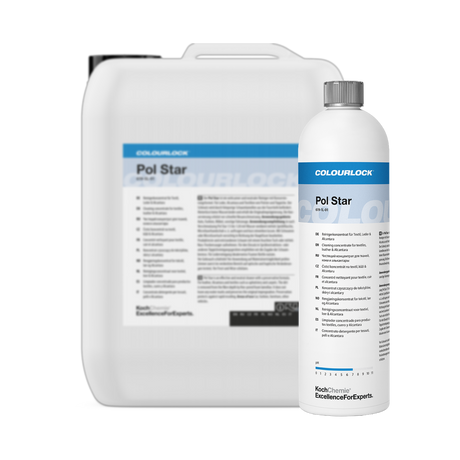
Seat covers and upholstery are their own topic, because pollen settles deep into fabric and Alcantara. Here the pH-neutral COLOURLOCK "Pol Star" cleans textile, Alcantara and smooth leather from a single bottle, diluted from 1:5 to 1:20. Open-pore nap leather like nubuck or suede won't take the concentrate, though, so for that see the separate care delicate nap needs.
For pollen trodden into rubber mats or badly greyed, tough hard plastics, the alkaline Mehrzweckreiniger "Mzr" at pH 12.5 breaks down stubborn organic grime, diluted from 1:5 to 1:50. That wide dilution range is the real advantage: 1:50 handles light pollen soiling, while for ground-in stains on the rubber mat you go to 1:5. It has no place on soft-touch surfaces, leather or paint, keep that line strict.

The cabin filter and the ventilation are where it goes wrong
The most expensive mistake in pollen season isn't the wrong cloth, it's the forgotten cabin filter. It's the first barrier between loaded outside air and the air you breathe, and in peak season it clogs up fast.
Leading filter makers and Germany's central motor-trade association (ZDK) recommend a firm interval of no more than 15,000 km, or twelve months at the latest. The ADAC puts the change at once a year or every 20,000 to 30,000 km, ideally in spring before pollen season. Activated-carbon filters, which also trap exhaust odours and ozone, are better swapped nearer the low end of that range, because the carbon loses its effect once it's saturated. Allergy sufferers are best off with a biofunctional premium filter, whose polyphenol coating can chemically bind more than 95 percent of the free allergens.
An overloaded filter gives itself away. If the inside of the windows fogs up heavily in the morning and the mist holds for more than ten minutes despite the defroster and the AC running, that's a clear sign of a water-saturated, often already germ-ridden filter element. At that point no amount of cleaning helps, only a replacement, which restores the dry air exchange.
It gets even trickier behind that, at the AC evaporator. Moisture condenses there constantly, and when the organic load from the pollen meets that damp and the residual heat after you park up, you get an ideal breeding ground for bacteria and mould. Their metabolism produces the classic musty smell that comes out of the vents in the first few seconds when you switch the AC on.
The commonest mistake is to mask that smell with an air freshener or a scent spray instead of dealing with the cause. The scent lasts a few days while the problem keeps growing underneath. The sensible move is an AC disinfection once a season, where the product reaches the evaporator through the recirculation system, paired with the fresh filter. One small habit helps as well: switch the AC off two or three minutes before you arrive and let only the blower run, so the evaporator dries out.
How to keep the cabin clean all through pollen season
If you want to clean your car interior in pollen season and keep it clean for good, you do it thoroughly once in the right order and then hold the rhythm. Vacuum and damp-clean first, then dress it antistatic, then keep an eye on the filter.
In practice that means: dust the vents and the cockpit with a soft brush and a high-pile, lightly damp microfibre, turning the cloth often. Clean the seats and upholstery with the pH-neutral concentrate, then seal the hard plastics with the antistatic dressing. Change the cabin filter before or during peak season, and if in doubt use the fogging test as an early warning.
It's worth a look outside too, because pollen gathers in door shuts and rubber seals. That's the job of Plast Star "Pss" for exterior plastic, which dresses and protects the door seals. This exterior product has no business inside the cabin, though, that's what the Top Star is for. Keeping that clean line between inside and out saves you picking the wrong product for the surface.
With this routine you flip the logic of pollen season on its head. Instead of fighting the returning film every day, the antistatic dressing takes away the ground it stands on and the fresh filter takes away its source. After that the car isn't just cleaner to drive, it's healthier too.

Detailing1-Insight: We test interior dressing outside our showroom in Nordhorn with a simple trick: after cleaning, hold the back of your hand just above the dry dashboard without touching it. If the fine hairs stand up or you feel a slight pull, the surface is still statically charged and will grab the next round of pollen straight away. Only once you've laid down a thin coat of Top Star "Ts" does that effect disappear. A common real-world mistake is too much product: a pea-sized amount on the applicator pad covers a whole door card, and anything beyond that goes greasy and starts binding dust itself again.
No time for the whole post? Get it summarized: