Iron fallout is a chemical problem, not dirt
Most people reach for the clay bar the moment the paint starts to feel like 80-grit sandpaper again on the bonnet. What nobody tells you: those aren't grit specks, they're tiny iron particles from brake dust that have been anchoring themselves in the clear coat for months. Clay shears off their heads. The root stays put and keeps rusting.
Iron fallout on car paint and wheels doesn't come off mechanically — it comes off chemically. Dedicated iron removers convert iron(II) and iron(III) ions into water-soluble complexes via thioglycolic-acid derivatives. You see the reaction as a purple bleeding effect. This guide shows you when you need which type, and how to strip the fallout without wrecking the clear coat.
What iron fallout is and why it digs in
About 90 percent of the iron fallout on your car comes from brake dust — your own and everyone else's. Brake discs and drums shed microscopic, red-hot iron particles every time you brake. Those particles fly toward the bodywork at several hundred degrees and burn straight into the soft clear coat on impact. What starts as 5-to-15-micrometre dots turns into a full-surface film once oxygen and humidity get to work and turn iron into iron oxide.
The worst contamination sits on the rear bumper, along the sills and inside the wheel arches — basically anywhere brake-dust aerosols get thrown up directly by the airflow. The rear window and the lower third of the front bumper also catch the brake dust of the cars ahead. If you rack up motorway miles or brake a lot in city traffic, iron fallout builds up faster than it does for someone who mostly runs country roads. The Pytrends seasonal wave for "flugrost entfernen" peaks in April with an index of 77 and climbs sharply from February on — which lines up with the leftover road salt that speeds up the corrosion in the clear coat on top of everything else.
The tricky thing about iron fallout is that it doesn't sit on top — it physically embeds into the clear coat. The micro-craters fill with iron oxide and become crevice-corrosion hotspots: oxygen keeps diffusing in, the iron keeps rusting, the clear coat gets undercut. A clay bar only shears off the tips; the roots stay put and quietly keep working. So if you only clay your iron fallout, you're buying three to six months of calm at most, until the paint surface turns rough again.
A simple diagnostic test replaces any pricey gauge: wash the paint, dry it, pull a clean bag over your hand and glide it across the bonnet and the bumper. Does it grate like a fine run of sandpaper? Then the fallout's there. Can you feel the specks even with a bare finger? Then it's high time for a chemical decontamination — and for a fresh sealant afterwards.
How thioglycolate turns iron into soluble complexes
Iron removers work off a thioglycolic-acid derivative — usually sodium or ammonium thioglycolate — as the primary active. The mechanism is called chelation: the sulphur-hydrogen group of the thioglycolate grabs iron(II) and iron(III) ions out of the brake-dust iron oxide and locks them into a ring-shaped molecular complex. Solid iron oxide becomes a water-soluble iron-thio complex that rinses away.
The signature colour shift from clear to red-purple isn't a marketing gimmick — it's chelation made visible. The telltale purple only appears once the iron-sulphur complex has formed, so the bleeding effect shows you exactly where iron is being dissolved right now. No purple bleeding anywhere means there was nothing to pull. On heavily loaded sills, on the other hand, the foam layer turns deep purple within 30 to 60 seconds, and the effect maxes out after three to five minutes.
The pH of modern iron removers deliberately sits in the skin-neutral range. The TUGA Chemie Flugrost-Teufel® works at pH 5.0 to 6.3 — mildly acidic, but a world away from the real acids wheel cleaners used to run. Acid-free means, in practice: no attack on anodised aluminium layers, no etching of chrome trim, no damage to ceramic coatings. The reaction is selective — it binds iron and leaves the polymer network, wax and clear coat alone.
Temperature matters. Below 10°C the chelation reaction turns sluggish, the bleeding effect drags, and the result stays half-done. Above 25°C — especially in direct sun — the water content flashes off too fast, the active dries onto the paint as purple crystals, and then only mechanical removal is left. That puts your working window between 10 and 25°C, ideally on cool, shaded paint.
Acid-free, pH-neutral, acidic — which type suits your paint
Three families of iron-fallout products are out there today. The acid-free thioglycolate products at pH 5 to 7 are the all-round choice for paint, wheels, glass and plastic — they react selectively on iron and spare everything else. The alkaline wheel gels with an added thioglycolate share hit brake dust in two stages: surfactants lift the greasy film first, then the thioglycolate goes to work on the baked-in iron. Genuinely acidic cleaners have all but vanished from the market, because they do too much collateral damage to coatings, chrome and aluminium.
The gel version makes sense anywhere the product mustn't run off. On a vertical bumper a spray product runs straight down within ten seconds, whereas a gel clings for 5 to 8 minutes and gives the reaction time to finish. The spray version covers big areas fast and is the better pick for the rear bumper, the rear window and the lower body panels. Need both? Then you keep two bottles on the shelf — or you grab a thixotropic shampoo like the INNOVACAR SD1 Iron Thixo Rapid, which washes and decontaminates in one pass.
Which type suits your paint comes down to the layer of protection underneath. A ceramic coating is completely unfazed by pH 5 to 7 — most coatings are rated stable down to pH 3. A classic carnauba wax slowly loses durability under repeated iron-remover use, because the solvent content softens the wax; once a season is no problem, every month cuts the wax's lifespan by about a third. On fresh 1K paint from the body shop you mustn't use any chemical product for the first six weeks — the clear coat isn't fully cross-linked yet and reacts sensitively to any solvent.
A second hard limit applies to carbon-ceramic brakes. The fibre structure can discolour on direct iron-remover contact — the manufacturer's note is unambiguous. If you run a Porsche Turbo wheel or a comparable setup, the product drifts onto the brake disc with the wind anyway. Fix: let the car cool down for 15 minutes before you start, spray only the wheel face on purpose, and keep out of the spoke depth.

The four-phase workflow: pre-wash, dwell, rinse, check
The most common application mistake is also the priciest: spraying iron remover straight onto dusty paint. On a still-greasy, unwashed surface the chelation gets stuck in the top layer of grime — the active never reaches the embedded iron, nothing happens, and half the bottle is wasted. So phase one is a full alkaline pre-wash: snow-foam lance or pH-neutral pre-cleaner, then a pressure rinse, then the main wash with shampoo concentrate and a microfibre mitt. Only on residue-free, dried paint does the iron product go on.
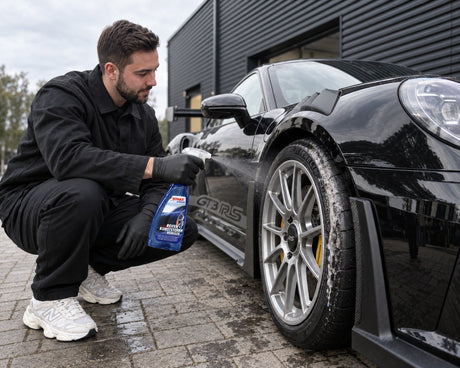
Phase two is laying it on from 20 to 30 centimetres away, evenly and not to excess. On heavily soiled cars, 150 millilitres is enough for the full coverage of bodywork and wheels — take more and you waste active and risk long dwell times. Focus points: rear bumper, sills, inner wheel arches, lower door edges, rear window and front apron. Work vertical surfaces with the gel version; horizontal surfaces can take a spray product too. Ambient temperature should sit between 10 and 25°C, and the paint needs to be at ambient temperature. Keep out of the sun — on a 50°C black bonnet the water content flashes off in seconds and the product crystallises as purple spots in the clear coat.
Phase three is patience: let it dwell three to five minutes, until the bleeding effect has fully developed. Never leave it longer than five minutes, never let it dry — either one turns rinsing into a chore and can leave active residue in the paint. Phase four is the residue-free rinse with a sharp pressure jet, top to bottom, followed by a clear-water pass. Then wipe dry and check with the plastic-bag method whether the surface is silky smooth now. Still grating slightly? Second round on the affected spots only. After that comes the ideal moment for a clay bar (for mechanical bits like paint overspray) and then for a fresh sealant — the paint is bone-clean now and takes coating or wax as well as it ever will.
Three mistakes show up in every second complaint: first, letting it dry, which leaves purple spots that only an aggressive polishing step will lift. Second, working in blazing sun, which flashes the product off before it can react. Third, combining it with a classic acidic wheel cleaner — the two actives compete, the chelate complex collapses, and the bleeding effect never shows. If you want to decontaminate, you work in sequence, not in parallel.
Seven iron-fallout removers from our range, head to head
The TUGA Chemie Flugrost-Teufel® is our shelf anchor. The German maker from the Sauerland runs a thioglycolic-acid derivative at pH 5.0 to 6.3 and delivers the classic bleeding indicator. It's cleared for paint, glass, chrome, plastic and wraps — strictly off-limits are hot carbon-ceramic brakes, fresh 1K paint (wait at least six weeks) and anodised aluminium. The bottle comes as a 1-litre spray and as a 5-litre canister for detailers with higher throughput. GHS07 classification with H302, H317 and H319 — safety goggles and nitrile gloves are a must, this is no hobby product.
The INNOVACAR D1 Iron from Italy runs a similar profile, but a slightly thicker consistency and a stronger fragrance. It comes as a 500-millilitre bottle, a 3-pack and a 4.54-litre refill — the last being the most economical option for regular users. The INNOVACAR SD1 Iron Thixo Rapid pairs iron remover with an alkaline shampoo in a thixotropic formula — foam the car, let it dwell, rinse, done. It saves the separate wash step, but on very heavy brake-dust loads it's a compromise; pure iron removers work harder.
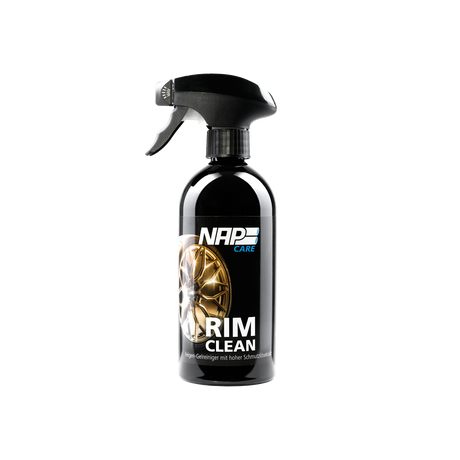
The NAP Care RIM-CLEAN is formulated as a gel, which makes it the vertical specialist for heavily loaded wheels. The gel clings to the wheel face for 5 to 8 minutes and buys the reaction time even in the hard-to-reach spoke depths. It comes as a 500-millilitre bottle and a 3-pack — the latter attractively priced for a whole season. The Dr. Wack A1 Flugrost-Entferner Gel is the German premium option in the same gel class: acid-free, high-cling, with a reaction indicator. Dr. Wack has been a constant in car care for decades and delivers a steady level of quality, but at a higher price point than most competitors.
The D-CON Light Pre-Cleaner & De-Ironizer is the lighter option in the D-CON range and meant for regular upkeep — a quick pass before every wash keeps the paint clean. The D-CON V4 Wheelcleaner & De-Ionizer is the stronger combination of wheel cleaner and iron remover for periodic deep cleaning — lavender scent as a pleasant quirk, which most iron-remover products don't solve half as charmingly (raw thioglycolate reeks of rotten eggs). If you're choosing between "top it up regularly" and "give it a proper going-over once a quarter", here are two graded candidates from the same range.

Which product for which contamination — a decision guide
For the annual spring decontamination after winter — one whole car a year, every exterior surface and the wheels — the TUGA Flugrost-Teufel® is our first grab. Plenty of spray reach, clear bleeding indication, well-documented GHS values, and a 5-litre canister that lasts 30 to 40 cars. If you're running a full detailing workflow ahead of a fresh ceramic coating, pair the Flugrost-Teufel® with a clay bar and an IPA wipedown — the paint is bone-clean afterwards and takes the coating chemically in full.
If the wheels are mainly the problem and the rest of the car is still fine, you reach for a gel: NAP Care RIM-CLEAN or Dr. Wack A1 Gel. The vertical wheel face demands a clinging formula — spray products are long gone before the reaction even starts. With a ceramic coating on the wheels, the NAP Care has proven itself for everyday use because it doesn't over-clean with surfactants — Dr. Wack is the premium pick there.
If you can't be bothered with two separate steps between the main wash and the iron step, take the INNOVACAR SD1 Iron Thixo Rapid — alkaline shampoo plus iron remover in one. It saves time on regular upkeep, but it doesn't replace a dedicated iron remover on heavily baked-in brake dust. For the everyday care round every two to four weeks it's an elegant solution. For the annual deep decontamination you still reach for the pure iron remover. If you want an honest workflow comparison for wheel products, you'll find it in our wheel cleaner guide — the pH logic there dovetails straight into this iron-remover guide.
One hard recommendation to close: whichever product you pick, plan a fresh sealant straight afterwards. Freshly decontaminated clear coat is physically bare — wax or coating now has a clear run and holds measurably longer than on a still-contaminated surface. Strip the iron fallout in spring and then drive six months without a sealant, and you've done half the work for nothing; within three months the next layer of brake dust settles in and the cycle starts over.

Detailing1 insight: We see a clear pattern in the orders — anyone who's worked with the Flugrost-Teufel® once buys it in the 5-litre canister the following year. The reason is usually not the price per litre, but the realisation that iron-fallout removal isn't a one-off event but an annual baseline step before every fresh sealant. Our tip: schedule the decontamination for the first properly mild day in April, when the paint sits between 12 and 18°C. The chelation reaction runs at its best in that window, the active doesn't dry out, and you've still got the whole warm season ahead for a fresh layer of protection — that's the care rhythm we put our own shop car through, too.
No time for the whole post? Get it summarized: