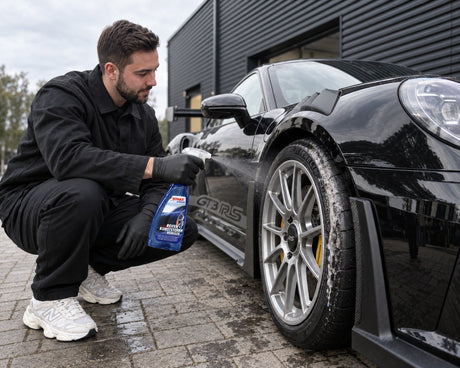
The right bug remover comes down to the residue, not the brand
Most people grab whatever bug remover shouts loudest in the ads. Spray it on, wait a bit, wipe it off with a rag — bugs gone, job done. That wiping is exactly what hands most paint a few fresh micro-scratches after every summer trip. And the residue that's been baking on the bonnet since the weekend run down to the Danube? The stuff off the petrol-station shelf won't shift it any more.
Bug removers split into three types: mildly alkaline with a gel body, strongly alkaline as part of a coating system, and pH-balanced for sensitive paint. Each type targets a different residue, and each one behaves differently with wax, sealant and clear coat. This guide shows which cleaner belongs on which front end — and why the right pick in May isn't the same one you'd reach for at the height of summer.

Three mechanisms break bugs down chemically, not mechanically
A bug splat on the bonnet isn't plain dirt — it's a chemical mix of three parts. The insect's hard exoskeleton is chitin, a long-chain amino sugar that water alone won't soften. Inside sit proteins from the haemolymph system, plus organic acids like formic acid and succinic acid. Let the lot dry in the sun for a few hours and the proteins cross-link, bonding to the paint so hard that even a second wash pass won't lift them.
Bug removers work on that mix with three mechanisms at once. First, surfactants drop the surface tension of the water — the cleaning solution creeps into the micro-pores of the residue and gets underneath it. Second, the alkaline environment hydrolyses the chitin and splits the long protein chains into smaller, water-soluble fragments. Third, organic solvents emulsify the greasy parts from bug blood and pollen wax, so you end up with an even suspension you can rinse off. That combination is what sets it apart from water or shampoo: run plain shampoo over a film of bugs and all you do is smear it across a bigger area.
Timing matters just as much. Any pH-neutral cleaner will still handle a splatter from this evening's drive. But once the sun has baked 50 to 60 degrees into a black bonnet, the protein matrix is denatured and welded into the clear coat like an anchor. At that point the mild petrol-station cleaner is out of its depth, and a dedicated bug remover has to step in. It's also why the old garage remedies — cola, oven cleaner, even glass cleaner — neither work nor stay paint-safe: they've got no calibrated surfactant blend, so they either bite into the clear coat or attack the rubber seals.
Three types of bug remover, three jobs
The bug removers that matter today split by pH range and carrier phase. Mildly alkaline gel cleaners sit at pH 9.0 to 9.5 — the range where alkaline hydrolysis reliably splits chitin and proteins but only slowly breaks down sensitive layers like Carnauba wax. The gel body here is no marketing gimmick, it's a must: twenty years ago, water-thin bug removers ran straight off a vertical bumper before the surfactants could do a thing. A thixotropic gel wraps around each bug splat and seals it in, giving the water phase time to work.
The second type is the strongly alkaline coating variant at pH 10.5 to 11. This is where system thinking kicks in: GYEON, CarPro and similar makers build their bug removers specifically for cars running their own ceramic coating. The higher alkalinity breaks baked-on residue down faster — three minutes instead of four or five — but the coatings take it, because they're built for it chemically. On a Carnauba wax the same cleaner would be too harsh and would visibly thin the protective layer after just a few uses.
The third type is pH-balanced, deliberately pitched in the neutral zone between 7 and 9. These cleaners don't lean on alkalinity but on especially active wetting and protein-dissolving additives. They're the right call for sensitive paint with organic protective layers — classic Carnauba waxes, polymer spray sealants or PPF film — where the protective layer itself is organic chemistry that too much alkalinity would attack. The trade-off is honest: these cleaners are milder, need longer, and are more likely to give up on baked-on summer grime than the alkaline types.

pH value: the number decides what's left of your Carnauba wax
A bug remover's pH value decides how often you can use it, and on which protective layer. pH 7 is neutral; in detailing, the 8 to 9.5 range counts as mildly alkaline and LSP-tolerant (LSP stands for Last Step Product — the final protective layer on the paint). Anything above pH 10.5 is strongly alkaline and measurably attacks organic protective layers. The pH scale is logarithmic, not linear: pH 11 isn't twice as alkaline as pH 9, it's a hundred times. A difference that looks small on the label is huge in chemistry.
That logic gives you a simple rule of thumb. If you fully decontaminate the car once a season and re-seal it afterwards, you can reach for the strongly alkaline bug remover — you're renewing the protective layer right after anyway. If you clean the front every week after a run and want your protection to last as long as possible, stay in the mildly alkaline range. And if you run a classic Carnauba high-gloss setup that counts every hundredth of a micron of layer thickness, take a pH-balanced cleaner and accept the longer dwell times that come with it.
Dwell time is the second dial. Two minutes are enough on fresh residue with a mildly alkaline formula; three to four minutes is the ceiling for most products on dried-on summer grime. Leave it longer and you don't get a better clean — you get etched paint, because the surfactant residue crystallises on a warm surface and leaves matt patches that only paint correction can remove. Make it a hard rule: the product never stays on the paint longer than the maker states, no matter how stubborn the residue looks. Better to run two passes back to back with a rinse in between.
Car in the shade, break it loose, rinse without touching
The workflow for a clean front end with no micro-scratches is always the same, whatever the cleaner type. Step one: park the car in the shade and let it cool until the bonnet is no longer warm to the touch. On a bumper sitting at 50 degrees, any bug remover dries so fast that the surfactants crystallise before they can work — the most common mistake detailers make in summer. Treat the car straight out of the sun and you'll be fixing paint afterwards, not bug residue.
Step two: spray the cleaner evenly onto the affected areas. Bumper, radiator grille, bonnet, mirror caps, windscreen and in many cases the A-pillars all need a coat. A standard trigger bottle only spreads it roughly — decant the cleaner into an iK Multi TR 1 spray bottle and you get a finer spread and real control over how much goes on. Rough figure: around 80 ml for an average car front, up to 150 ml after a long motorway run with a heavy load of bugs.
Step three: let the cleaner dwell for two to four minutes — the exact time is on the bottle and it's not up for negotiation. The residue must not dry out while it works. Working in full sun or low humidity, mist it lightly with water so the reaction keeps running in the water phase. Touch the residue with a microfibre towel and you drag the chitin particles across the paint, producing exactly the swirls the chemical cleaner is meant to avoid.
Step four: rinse with the pressure washer from 30 to 50 centimetres away, with no pressure on the nozzle. Low water pressure at high volume flushes the emulsified residue better than a sharp jet, and nothing is left behind on the paint. Only then comes the pre-wash with Snow Foam, and after that the contact wash with shampoo. This order is the only one that brings the micro-scratch risk down to near zero: dissolve it chemically, rinse without touching, and only then reach for a towel.

Four cleaners from the Detailing1 range
In the Detailing1 range we carry four bug removers that between them cover the whole spectrum. The TUGA Chemie Insekten-Teufel® is our mildly alkaline gel cleaner and the go-to for the keen private owner. At pH 9.0 to 9.5 it sits right in the LSP-tolerant range, the gel body clings to vertical front panels, and the formula runs on under five per cent surfactants with a moderate glycol ether as the solvent. Available in the 1-litre standard bottle for seasonal care and the 5-litre canister for regular users. TUGA Chemie has been making it in Osnabrück for decades, and the formula is well established across the DACH market.
If you run on the GYEON Q² coating track, reach for the GYEON Q²M Bug&Grime. At pH 11 it's clearly more alkaline, the dwell time capped at three minutes, but it breaks baked-on high-summer residue down faster. It's system-consistent with every GYEON coating — used correctly and for three minutes tops, it doesn't measurably touch Q² coatings. A 500 ml bottle covers three to six treatments at moderate levels of bugs; the 1-litre and 4-litre are for regular users or small detailing outfits.
For sensitive paint with Carnauba wax, PPF film or a spray sealant, we recommend the Koch-Chemie THE FINISHER InsectOff. This is the pH-balanced option from Koch-Chemie's consumer line, deliberately tuned to go as easy on the protective layer as possible. The wetting additives creep into honeycomb grilles and mirror seams; the active ingredient breaks the bond layer loose without attacking the organic wax or polymer layer underneath. A 500-millilitre bottle, ideal as the first step in the pre-wash chain before a foam wash.
For commercial detailers and shops getting through multiple litres a day, the Koch-Chemie Insect & Dirt Remover Idr is the answer. The 10-kilogram container is the pro version with a higher surfactant concentration, faster action and the option to dilute. Idr works strongly alkaline, is built for the professional pre-wash of fleet vehicles, and only makes sense when your throughput justifies the big container — otherwise the 5L Insekten-Teufel or the 4L Bug&Grime are the more manageable choices.
In a 2026 comparison run by the big car magazines, the established bug removers landed cleaning scores around 80 per cent — not one product in the test hit a full hundred. That's the honest read: even the best bug remover is no substitute for a quick rinse the same day. Let the residue sit in the sun for three days and you'll be looking at two dwell cycles afterwards, or a light polish in the end after all. Verified Trusted Shops reviews for the TUGA Insekten-Teufel are still in the early days — the few that exist sit at full stars, but the season's too young yet for a reading you could lean on.
Which cleaner for your front end
Three clear recommendations to choose from. If you look after a daily driver that maybe runs a spray sealant or wax, and you want to freshen up the front after every longer trip, the mildly alkaline gel cleaner serves you best. The Insekten-Teufel delivers the mix of reliable action, vertical grip and LSP tolerance that fits this exact case. One 1-litre bottle covers about ten to fifteen treatments — half a season at weekly use.
If you maintain a car on a live GYEON Q² system — MOHS, PRIME or Cancoat as the coating — stay in the system and take the Q²M Bug&Grime. The mix of stronger alkalinity and coating-specific development is worth watching those three minutes for — and in return the coating stays measurably more intact across the season than if you mix in cleaners from other systems.
If you care for a high-end sealed weekend car or show car, where every application has to go easier on the protective layer, reach for the pH-balanced InsectOff. A little less punch against baked-on summer grime, but across the season the gentlest option for Carnauba and PPF. If you detail professionally and genuinely clean fronts every day in fleet quantities, the Idr in the 10-kilo canister gives you the lowest cost per litre and the fastest cleaning.
And if you're still unsure: the mildly alkaline starting point is never a wrong call. You can't really go wrong on most paints and protective layers, the dwell time gives you enough of a buffer, and the gel body works right where you lay it down. Give it a go on this first wave of bugs this season — and take a look at our coating reactivation workflow if the sealant system is due a refresh after winter anyway. You'll find the full bug remover selection in that category in the shop.
Detailing1-Insight: What we see day-to-day boils the most common mistake down to one sentence — the bug remover goes on too early or too late. Too early means: car straight in the sun after the trip, bonnet at 50 degrees. The surfactant residue dries faster than it dissolves the bugs, and you're left with matt spots that won't wash off any more. Too late means: residue sitting on the paint for three days, burnt through the Carnauba layer and anchored into the clear coat. At that point even the strongest cleaner only gets you 70 per cent there, and the rest only comes off with a polish. The sweet spot is the same day, ideally within the hour of getting home, car in the shade, five minutes' wait for the heat to leave. Then the mildly alkaline gel cleaner with three minutes of dwell time. Across a whole season of washes, that's what makes the biggest difference between paint that still looks fresh in autumn — and paint already showing matt traces in July.
No time for the whole post? Get it summarized: